
Bind Screener
Screening for brain-related comorbidities in Duchenne musculardystrophy: Construction, reliability, and validity of the BIND screener
 Living with Duchenne muscular dystrophy (DMD) often involves non-motor difficulties. Many children, adolescents, and adults also experience challenges related to attention, learning, memory, emotions, or behaviour. These difficulties may impact school performance, social relationships, and family life. Parents frequently report that these issues can be as worrying (or even more so) than physical symptoms. However, they are often identified late or not assessed at all.
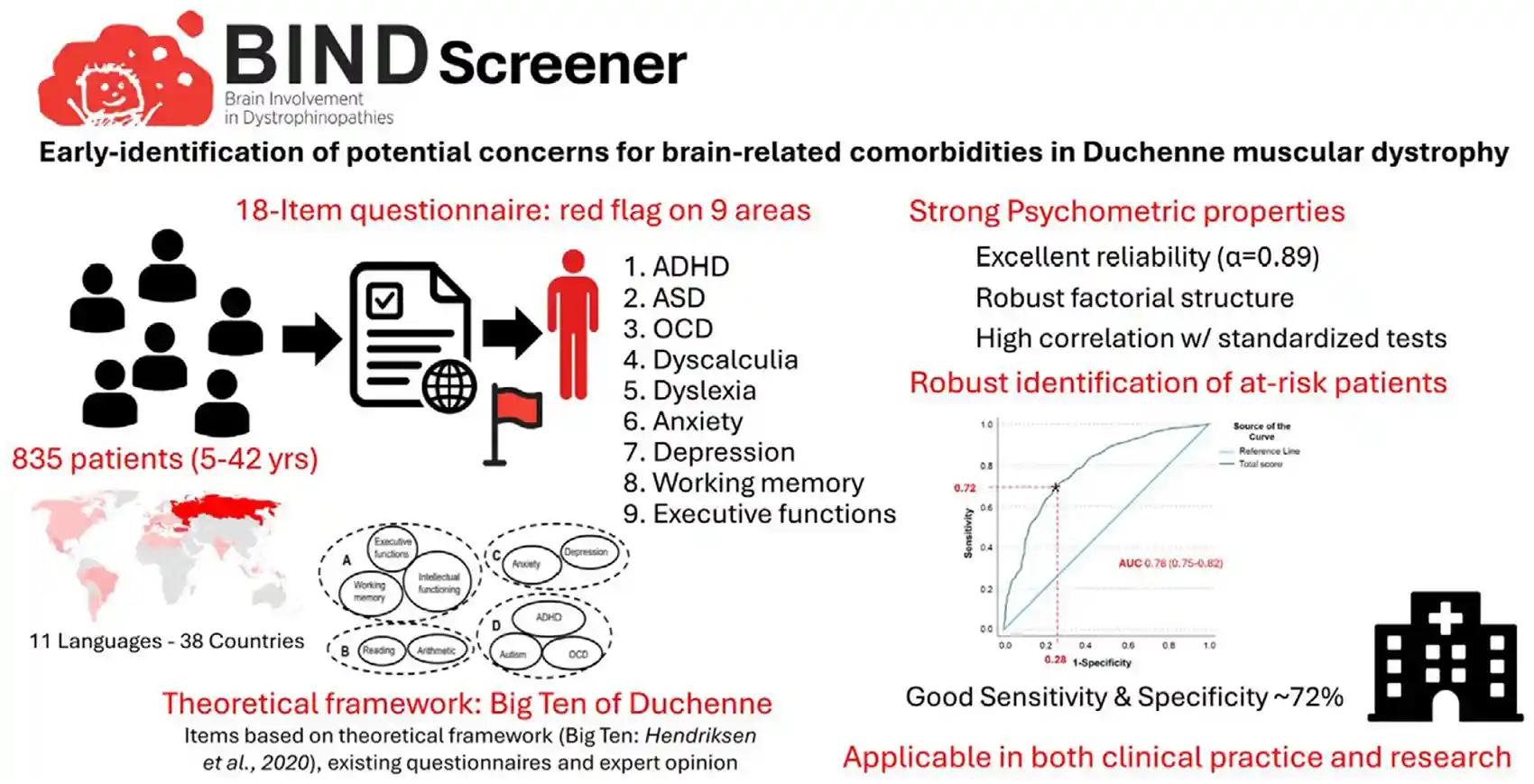
The Brain Involvement in Dystrophinopathies Screener (BIND-S) is a short questionnaire designed to help families and healthcare professionals detect possible brain-related concerns early, so that support can be provided sooner. It includes 18 simple questions about areas such as attention, memory, reading, anxiety, autism-related traits, and mood. The questionnaire can be completed by parents, caregivers, or the individual with DMD and takes less than 5 minutes. It does not give a diagnosis but highlights areas that may require further evaluation.
In this international study, 835 individuals with DMD from 38 countries (aged 5–42 years) completed the screener in 11 languages. More than half (55%) already had at least one diagnosis such as attention-deficit/hyperactivity disorder, dyslexia, or anxiety. The results showed that the BIND screener is reliable and accurately identifies individuals with a higher risk of having a neurodevelopmental or neuropsychiatric condition. A score of 20 or higher (out of 72) on the screener is recommended as an indicator to consider further assessment.
In summary, the BIND-S is a quick and accessible tool that helps and empowers families and healthcare teams to recognise brain-related challenges in DMD earlier, encouraging timely in-depth assessment, intervention, and better support for everyday life.
For more information about BIND-S contact info@worldduchenne.org.

Download
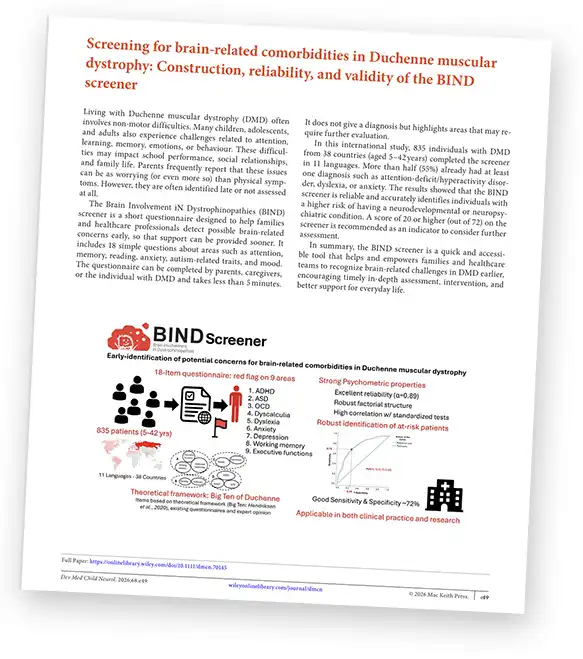
- View the summary
- View the full paper
- Upcoming publiction: Manual for Administration, Scoring and Interpretation
Citation: (2026), Miranda R, Weerkamp PMM, Kolesnik A, Geagan C, Chieffo D, Suárez-Bagnasco M, Skuse D, Vroom E, Niks EH, Vissing J, Desguerre I, Straub V, Muntoni F, Mercuri E, Hendriksen JGM, BIND Consortium. Screening for brain-related comorbidities in Duchenne muscular dystrophy: Construction, reliability, and validity of the BIND screener. Dev Med Child Neurol. 2026;00:1–17.
 Work funded by the European Union Horizon 2020 Framework Programme for Research and Innovation through the project Brain Involvement iN Dystrophinopathies (BIND) (grant agreement no. 847826).
BIND-S © 2026 World Duchenne Organization (WDO) and the authors. All rights reserved. The BIND-S may be used for clinical and research purposes. Any commercial use requires prior written agreement with the World Duchenne Organization (WDO).

Copyright World Duchenne Organization © 2024